
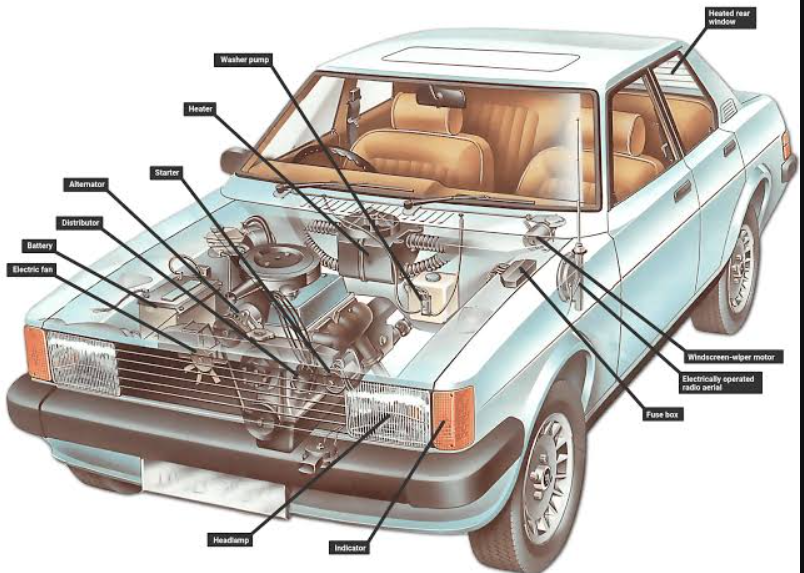
Course Summary: Automotive Electrical Systems
Course Objective
To equip students with the theoretical knowledge and practical diagnostic skills needed to service, repair, and maintain modern vehicle electrical and electronic systems, preparing them for ASE A6 certification and a career as an automotive electrical technician.
Duration (Typical)
-
8–16 weeks (per level)
-
Often divided into Level I (Beginner) and Level II (Advanced)
Target Audience
-
Aspiring automotive technicians
-
Mechanics seeking electrical system specialization
-
Hobbyists with basic tool knowledge
Module Overview
| Module | Topics Covered | Key Skills Gained |
|---|---|---|
| 1: Fundamentals | Ohm’s Law, voltage/current/resistance, series/parallel circuits | Use DVOM, perform voltage drop tests, read wiring diagrams |
| 2: Power Systems | Battery, starting (cranking), charging (alternator) | Test battery state/load, diagnose no-crank/no-charge conditions |
| 3: Ignition & Engine Management | Ignition coils, spark plugs, ECU, sensors (crank, cam, O2, TPS), actuators | Diagnose no-spark, use scan tools, interpret sensor data |
| 4: Lighting & Body Systems | Headlights, turn signals, power windows/locks, wipers, instrument cluster | Trace circuits, repair non-functional lights/accessories |
| 5: Advanced & Emerging Tech | CAN Bus (multiplexing), ADAS, hybrid/EV high-voltage systems | Diagnose network faults, follow HV safety procedures |
Key Hands-On Labs (Typical)
-
Measuring voltage, current, and resistance on live circuits.
-
Performing a voltage drop test on starter and ground cables.
-
Load testing a 12V battery.
-
Alternator output test (checking charging voltage).
-
Using a wiring diagram to locate an open or short circuit.
-
Parasitic draw test (finding a battery drain).
-
Scanning and interpreting CAN Bus communication faults.
-
High-voltage safety shutdown procedure (hybrid/EV).
Certification Preparation
-
ASE A6 (Electrical/Electronic Systems) – the industry standard credential for auto electricians.
Tools You Will Learn to Use
-
Digital Multimeter (DVOM)
-
Test light / power probe
-
Battery load tester
-
Alternator/starting system tester
-
Scan tool (OBD-II)
-
Lab scope (oscilloscope) – advanced
-
Wiring diagrams (digital or printed)
Typical Prerequisites
-
Basic mechanical knowledge (helpful but not always required)
-
Safety awareness (shop class or orientation)